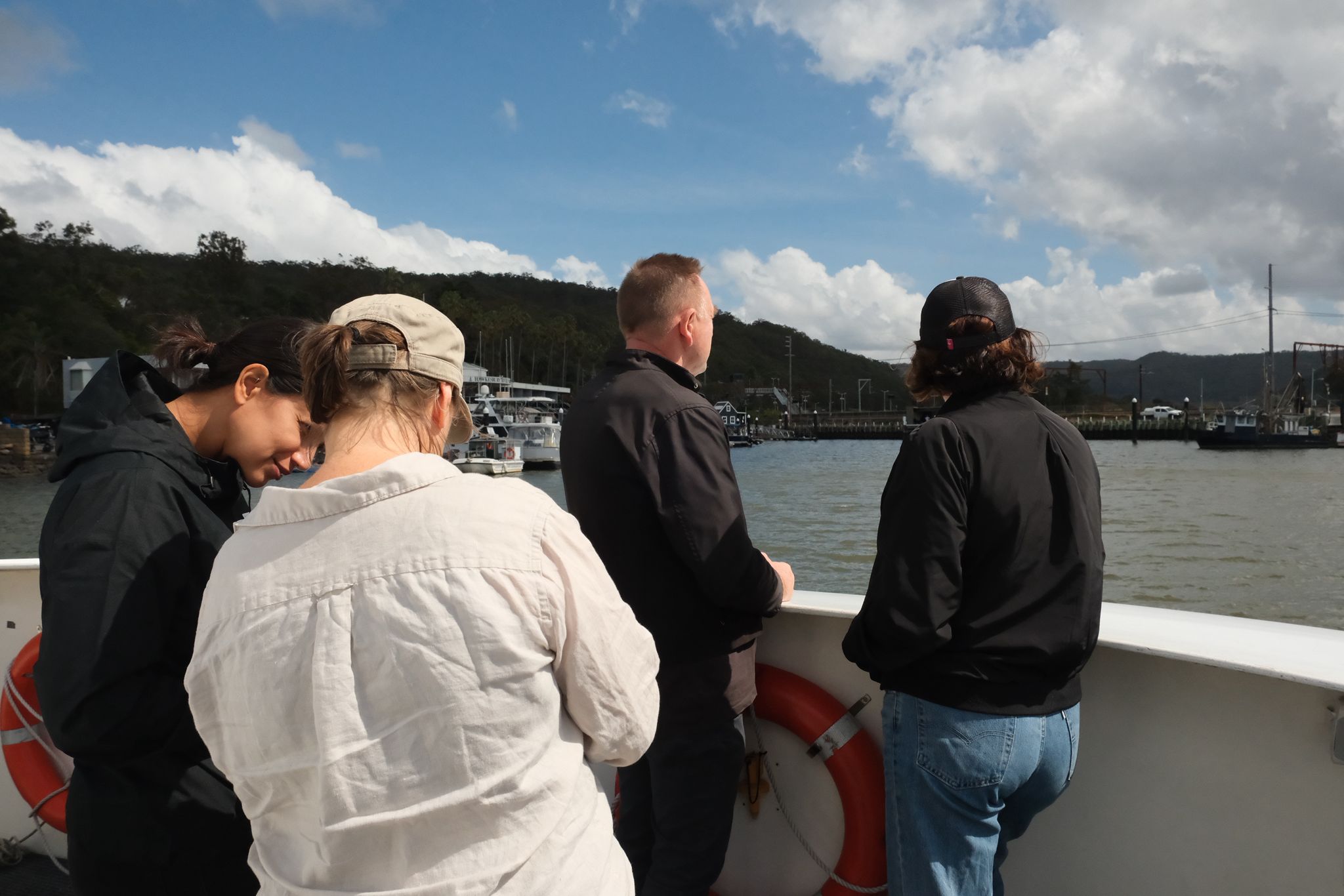
We joined a unique event hosted by the NSW Branch of the Australian Marine Sciences Association (AMSA) on the Hawkesbury. It brought together researchers, councils, government, and community organisations with a shared interest in estuaries.
Over a delightful 2 hour river cruise down the Hawkesbury, attendees heard talks by researchers and industry leaders (including us), nibbled on snacks, and received a tour of river landmarks – all while networking and fostering a sense of community. We shared our work on urban wetlands and explained how better visualisation of wetlands and waterways could contribute to better care of these important ecosystems.
Huge thanks to the Hawkesbury Estuary Coastal Management Program councils for supporting the event, our AMSA NSW organiser and C-SERC colleague Carla Sbrocchi, for inviting us.
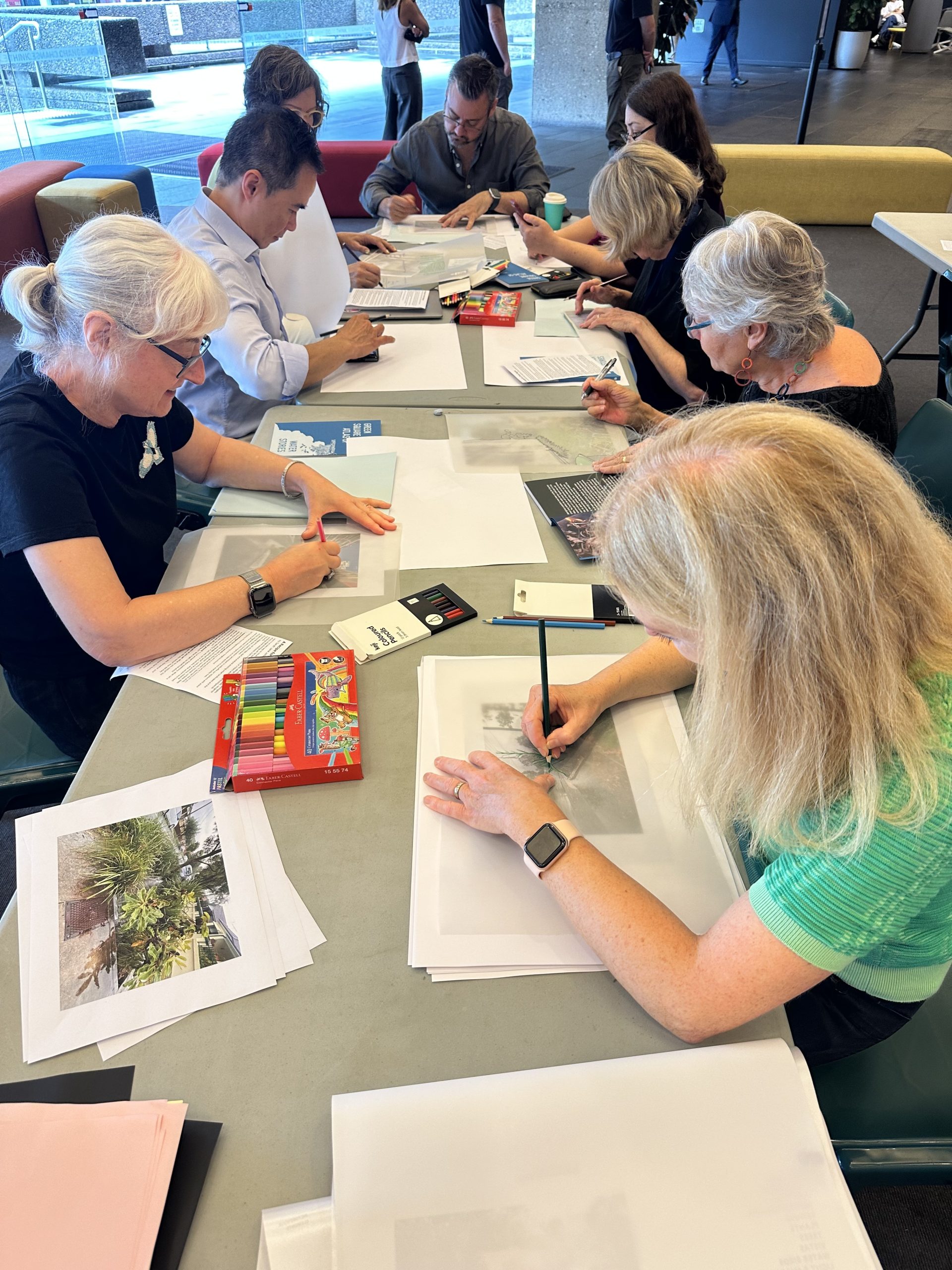
When is a tree not just a tree? and a drain not just a drain? When it’s a rain garden! Thanks to everyone who joined our Climate Action Week workshop on visualising urban ecologies. Climate Action comes in many different forms- the way we visualise nature in cities shapes how we see our role in caring for the urban environment, especially at this time of climate-driven environmental change, our engagement with urban ecologies is crucial.
In this workshop, participants learnt to use “photodiagrams” — a creative tool for reading, analysing, and sharing your local ecology. Explore the impact of climate change and uncover hidden stewardship practices in your neighbourhood.
Participants were asked to bring a photo and follow a series of steps to better understand and engage with urban ecologies!
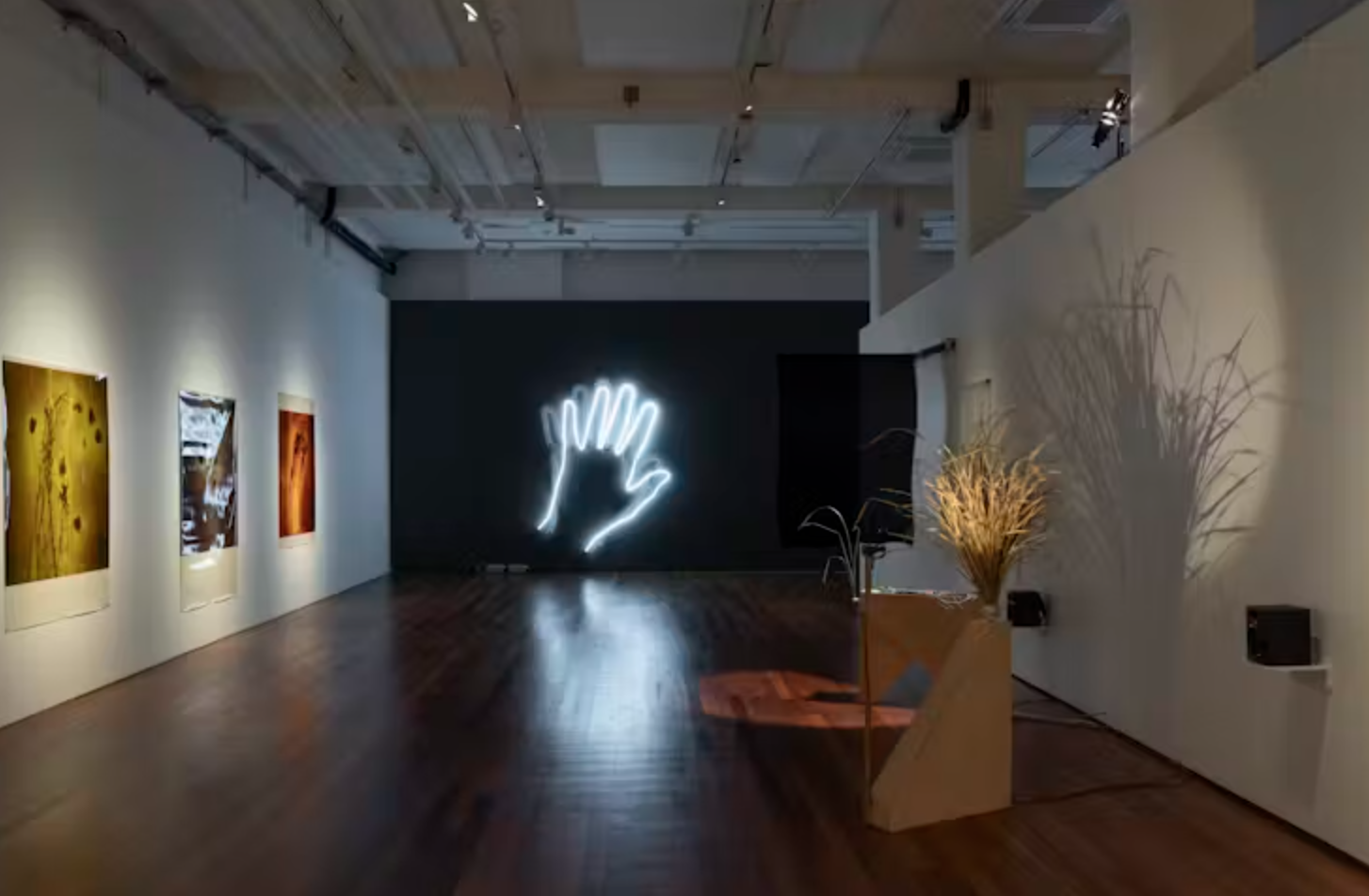
In December 2024, DRAW Space will present Group Show / WALK WITH ME, an exhibition by eight artist-researchers who use walking as a deliberate strategy to reveal and disseminate new knowledge.
The exhibition will open at 6pm on Thursday 28 November. Join the artists and DRAW Space team to celebrate.
Once the primary mode of transport, part of the continuum of human history, walking in the First World is now consciously chosen, an act of resistance against loss of time, space and embodiment. Since the 1960s, when art transitioned from object-making to an investigation of ideas, valuing process over product, opportunities arose for the artist to see the body as a medium and walking as an ordinary activity from which the extraordinary can be derived.
Curated by walking artist, Melinda Hunt, WALK WITH ME will present six projects that foreground preoccupations with and responses to habitat loss and species extinction, connection with urban ecologies, the colonial project, artistic and scientific activity centred on walking, and site-specific atmospheres, among other concerns. Each project generates drawing as an output. To find out more about individual projects, read the artist statements below.
WALK WITH ME includes an exciting public program of walking events and activities during which participants are invited to join the artists in exploring surrounding suburbs on foot and contribute drawings to the exhibition.
WALK WITH ME features the work of:
Alexandra Crosby, Ilaria Vanni, and Sarah Jane Jones
Melinda Hunt
Luca Idrobo
Linda Knight
Kiera O’Toole
Mia Salsjö
The exhibition runs from 6pm on 28 November to 5pm on Sunday 22 December.
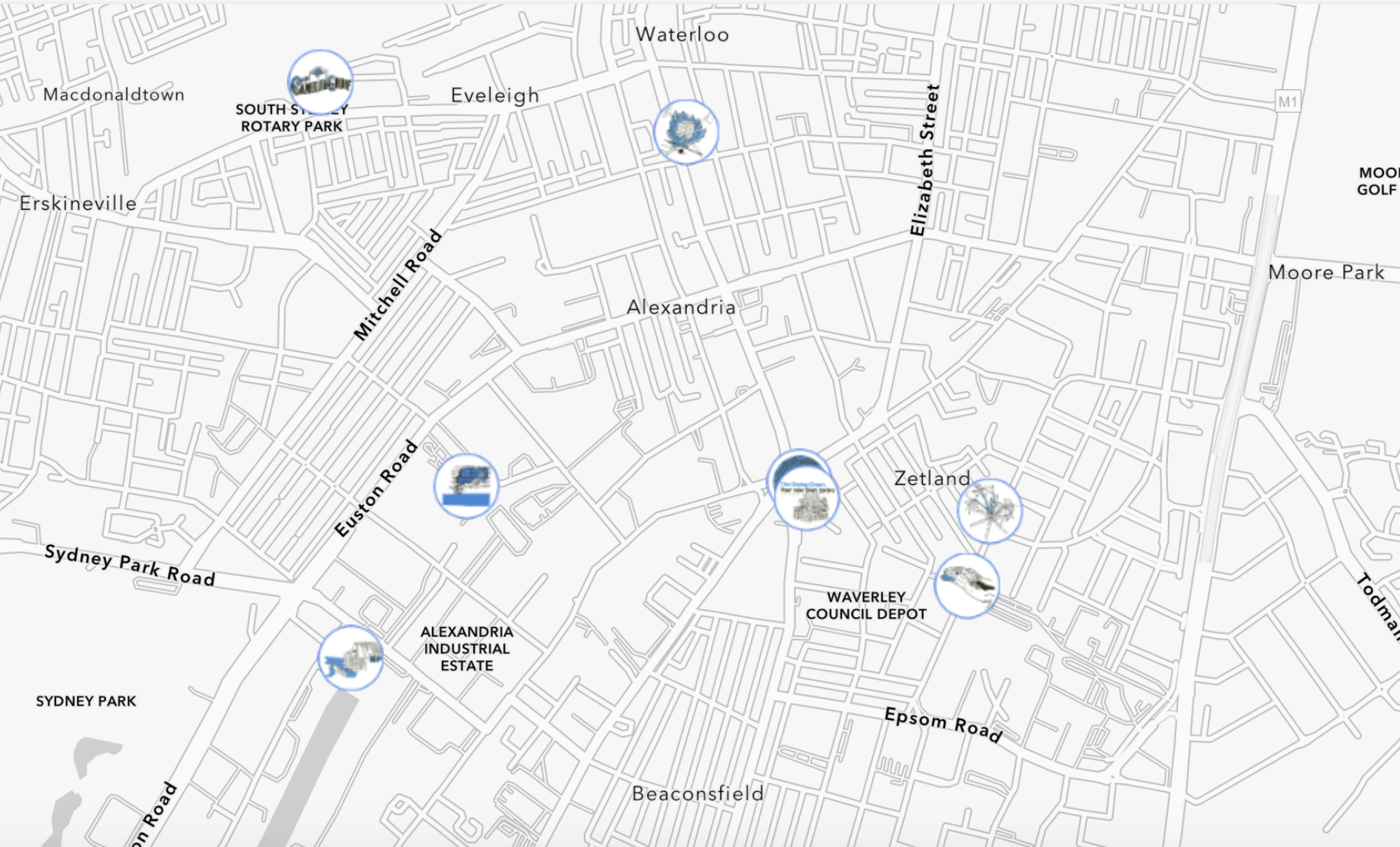
For the exhibition WALK WITH ME, Alexandra Crosby and Ilaria Vanni and Sarah Jane Jones have created three ‘photo diagrams’ researched through walking ethnographies of Sydney Park.
Alexandra Crosby and Ilaria Vanni have worked together as Mapping Edges for over a decade. They combine walking and mapping methodologies to guide people to connect with their neighbourhood ecologies. In this project, they work with award-winning visual communication design researcher Sarah Jane Jones to map the water trajectories intersecting in Sydney Park’s constructed wetlands and visualise them as a working landscape.
Photo diagrams are a technique to move between photography as descriptive documentation and documentation of non-representational dimensions. They can bring a visual communication perspective into debates on conveying the non-representational in visual form, and in this way contribute to making wetlands legible in urban environments.
During the exhibition, Crosby, Vanni and Jones will lead a public walk entitled Water Walk. Over 2 hours, participants will trace the movement of water under the surrounding suburbs concluding at Sydney Park. Registration will be required for a maximum of 12 people.
The Ian Potter Centre at Melbourne’s Federation Square is located on the banks of the lower stretches of Birrarung, the Yarra River. For Reimagining Birrarung Design Concepts for 2070, on until 2 February 2025, the river flows into the gallery through ideas, images, objects and stories.
In this bold and unusual exhibition, we listen to traditional owners and get inside the imaginations of eight of Australia’s most innovative landscape architecture studios. By looking at “possible” and “preferred” futures, this exhibition frames the river as a complex, diverse, interconnected ecosystem that nurtures our health and is essential to human and non-human communities.
Urban rivers are being rethought internationally. In Australian cities, where big city rivers are often estuaries, the problems of waterways and wetlands are inseparable from colonisation and urbanisation. The fate of these cities as the climate heats up is tied to their rivers.
Melbourne was established in 1835 at the lower stretches of Birrarung where salt water from Port Phillip Bay travels about 10 kilometres upstream. Now metropolitan Melbourne dominates and influences the landscape of its lower reaches.
Rivers are Country
Entering the gallery, we are invited to listen to Birrarung. The river’s voice is spoken by Uncle Dave Wandin, Wurundjeri Woi Wurrung Elder and Birrarung Council member. Originally commissioned by the 23rd Biennale of Sydney, the video portrait provides an important transition from the bustle of Melbourne, into the contemplative space of the exhibition.
Many will know the river as the Yarra, or Yarra Yarra – but this was a mistranslation by a surveyor in the 1830s of another Aboriginal word Yarro Yarro, “it flows”.
The misnamed river has suffered from disconnection from its traditional owners and severe environmental degradation.
In 2017, the Yarra River Protection (Wilip-gin Birrarung murron) Act was passed by the Parliament of Victoria, to protect the river for future generations and to recognise the river and its lands as a single living and integrated entity. Uncle Dave Wandin is a member of the Birrarung Council, appointed to work with Wurundjeri Woi Wurrung Elders and communities, to provide independent advice to the government on the implementation of the Act.
Barracco and Wright’s contribution to the exhibition builds on the impact of this legislation. Speculative Policies displayed as an historic document from the future in a 2035 cabinet.
Installation view of McGregor Coxall’s design for reimagining Birrarung. NGV Australia/Photo: Sean Fennessy
Colonial histories
Thinking about legislation in future worlds helps remind us the challenges of urban rivers – pollution, storm water management, and flooding – have colonial histories.
Waterways have long been treated as dumping grounds for Australia’s industrial progress.
In their work Aqua Nullius, not-for-profit multidisciplinary design and research practice OFFICE points to viticulture (winegrowing) and golf courses as culprits of water extraction in the Birrarung catchment.
The problems arise not only where water is redirected as a resource for elites, but also where the connections between waterways and wetlands are disrupted by roads, estates and colonial land use. Billabongs are cut off from their sources and creeks are converted to drains. Wildlife such as turtles, platypus and birds lose their habitat corridors.
Terra Nullius is well known as the concept that shaped colonists approach to Australia. Aqua Nullius, OFFICE argue, is just as significant. Rivers are country – and need to be respected, cared for and healed.
Designers from OFFICE assert the Terra Nullius concept applies to water too. NGV Australia/OFFICE
Seeing like a landscape architect
By combining ecological knowledge with architectural forms, landscape architects are often leading these goals alongside Aboriginal people. While many of Melbourne’s residents and visitors enjoy the outcomes of their designs in city parks and green infrastructure, landscape architects are rarely the focus of exhibitions in major art galleries. This exhibition shows how design projects can invite us to imagine urban rivers differently using a range of tools that bring life to possible futures.
In this exhibition we see images, maps, models, flags, plans, animations, timelines, and even a uniform design for a future “bio-zone guide”.
The Birrarung Catchment by McGregor Coxall projects an animated map at waist height. It shows us the past, present and potential future of the catchment, highlighting the evolution of Birrarung’s lands, health, waterways, and its relationship to people.
Presented as a map that shifts over time, the table top animation shares a rhythm with two screens on the wall, one with a population counter and one with the changes of flow within the catchment. These three elements link the growth of urban population to the disruption of the rivers flow. Dealing with Melbourne’s anticipated population growth, the projection looks forward in time proposing ways to care for the river by establishing the Great Birrarung Parkland.
What’s good for Birrarung …
Not all rivers are created equal. Melbourne is a river city, planned, designed, built and managed around Birrarung.
A short walk from the gallery, rowers launch into the river and lovers hold hands on its banks. Melbourne is Birrarung and we can see it as we move around the city. But all cities have waterways and wetlands, many less visible.
Place-based approaches to caring for urban water is needed everywhere. And this can have flow-on effects. If we start to care for minor creeks and estuaries that are built over and forgotten, we understand connections between people, nature, water and Country. This exhibition shows those visions for the future require research, vision and political will.
Ecology has always fascinated Australian artists. Think of landscape painters like Arthur Boyd (1920–99), who was inspired by nature and committed his career and legacy to protecting it.
Boyd spent the latter part of his life painting the Shoalhaven River at Bundanon, New South Wales. The use of the land along the river for agriculture was causing erosion, disturbing soil, plant and animal life. With increased tourism and intensified use of the river, Boyd feared further destruction, and so Boyd and his wife bought land along the river during the 1970s – gifting it to the Australian people in 1993.
Since scientific studies began showing the undeniable human impacts on the climate, ecology and art have been brought together in new and urgent ways.
Ecological art can communicate the results of scientific studies, create opportunities for community-based interventions, and can even function in their own right as restorations of ecological systems.
Ecology and art
If you have ever enjoyed Sydney Park you were visiting the integrated environmental artwork Water Falls by Jennifer Turpin and Michaelie Crawford.
Water Falls consists of two sets of terracotta troughs, arranged in dramatic zig-zagging lines. As part of a constructed wetland ecosystem, the artwork harvests stormwater from the surrounding streets, preventing flooding and providing habitat for native animals. It is experienced as the rhythmic sight and sound of falling water. Ecology as art.
Ecological artists deal with the politics, language, culture, economics, ethics and aesthetics of ecology in ways that scientists sometimes fall short.
In 2012 and 2021, Tega Brain engineered an artificial wetland system which could also wash dirty clothes. Coin Operated Wetland shows how water, although often made invisible by the urban life it sustains, is always circulating and part of us and our cities.
Many First Nations artists have pointed out the entanglements of language and Country with ecological knowledge.
Quandamooka Artist Megan Cope makes sculptural installations that engage with local ecological systems. In her work Kinyingarra Guwinyanba (“a place of oysters”, 2022), she plants sea gardens with oysters to create “a living, generative land and sea artwork that demonstrates how art can physically heal country”.
Ecological art brings scientific language into the gallery and into our conversations. Using language in different ways can be a way of rethinking human relationships to land, water and atmosphere.
Topographies
There are currently two exhibitions in Sydney showcasing interdisciplinary research on climate change communicated in artistic ways.
Topographies at the Sydney College of the Arts engages with topography: the study of the forms and features of land surface. Curator Vicky Browne describes topographies here as “the process of marking out the shape of the world”.
Topographies at the Sydney College of the Arts Gallery. Jessica Maurer
Magnetic Topographies, an artist collective who are featured in the exhibition were in residence in Bundanon in 2023. They extend topographic research to “avian navigations”, “earthly togetherness” and “repellent terrain”.
Biljana Novakovic’s Listen for the Beginning (2024) is an enormous piece of light blue fabric is embroidered with coloured words and phrases layered over one another, an interpretation of Gooliyari, known as Cooks River, Sydney, and sometimes as Australia’s sickest urban river.
Magnetic Topographies & Friends, Biljana Novakovic, Listen for the Beginning, 2024 Fabric, 140 x 800cm. Jessica Maurer/Sydney College of the Arts
Ben Denham’s work A Topography of Air (2024) is a collection of multisensory ecological communications and interventions. Custom electronics, barometric pressure sensors, modular synthesisers and wooden boxes are combined with dried native grasses and “the atmosphere”. We feel as though we are in a laboratory – but we are not quite sure of the experiment, or what is being measured.
Ben Denham, A Topography of Air, 2024, Topography of Air: Generalised Diagram, 2024 Diagram, text (via QR code). Jessica Maurer/Sydney College of the Arts Gallery
Alongside this work is another piece by Denham. Generalised Diagram (2024) employs the visual language of science in the form of a flow chart, black lines on a white page, pinned to the wall, showing feedback loops between oscillators, amplifiers, bodies, politics and the atmosphere.
Denham’s sculpture and flow chart work together to explain how to understand features on maps, in graphs, and in the terrain in sensory ways. “We see the visual form on a map, we feel pressure gradients on our skin,” Denham explains.
Living Water
At the University of New South Wales Library, Living Water celebrates 75 years of water research from faculties and institutions across NSW.
The River Ends at the Ocean is a collaborative project engaging with diverse knowledge about Gooliyari.
In 2021, Aunty Rhonda Dixon-Grovenor, Astrida Neimanis and Clare Britton led a group of approximately 60 walkers along the concreted banks, restored edges, and straightened channels of the estuary, following the tide out to Kyeemagh Beach.
At the entrance to the exhibition, a film of the walk by Aunty Rhonda Dixon-Grovenor layers over a flowing sketch by Britton of the Cooks River and its tributaries.
Another collaborative creative work, Rippon Lea Water Story, (2023) explores waters, memory, plant and animal life, and infrastructure at Rippon Lea, a colonial estate in Melbourne on Boon Wurrung Country.
In the dark space of the gallery, we are asked to listen deeply to the sounds of Melbourne’s subterranean waterways, recorded with specialist microphones called hydrophones. These underwater microphones were developed by scientists to record biotic, abiotic and anthropogenic sounds in marine environments.
Here, these recordings allow us to hear the sounds of water flowing underneath the concrete surfaces of the city.
Moving forward with art and science
Visual artists synthesise and represent different types of knowledge and language.
The exhibitions are bringing new audiences to ecological science and developing understandings needed to convince people and organisations to take action on climate change.
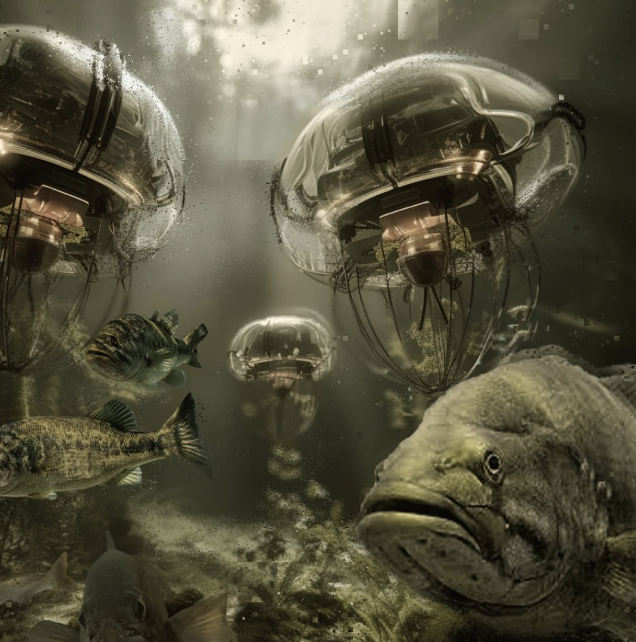
PhD student Holly O’Neil joined the Embodied Filmmaking Course ‘Bodies of Water’ run by IMPRINT documentary collective.
IMPRINT is an international, experimental, women, trans and non-binary led film collective examining the body and processes of embodiment in documentary filmmaking.
Founded in 2020, IMPRINT established the practice of embodied documentary filmmaking, a changing, experimental approach to creative documentary filmmaking that centres somatic practices, the body, and lived experience through the lens of the body politic.
During the course, Holly made the film , River Brain.
Welcome to Holly O’Neil, who has joined the project as a PhD student. Holly is an an anthropologist-artist with degrees in social anthropology, illustration, animation, and art. Her project ‘‘(In)visible Wetlands: Making the unseen seen through narrative, visual ethnography in Sydney’ will contribute to visualisation of Sydney’s buried wetlands.