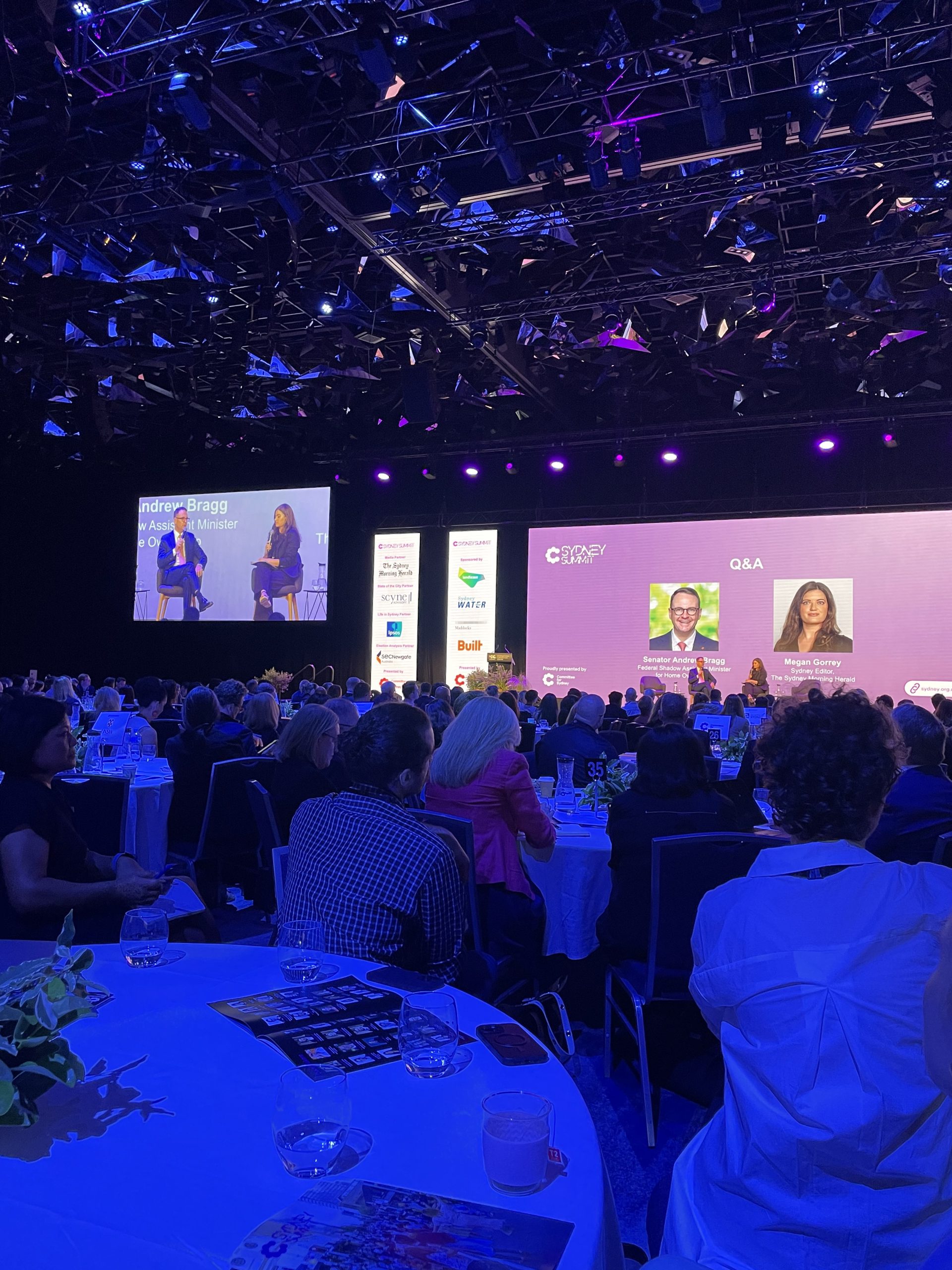
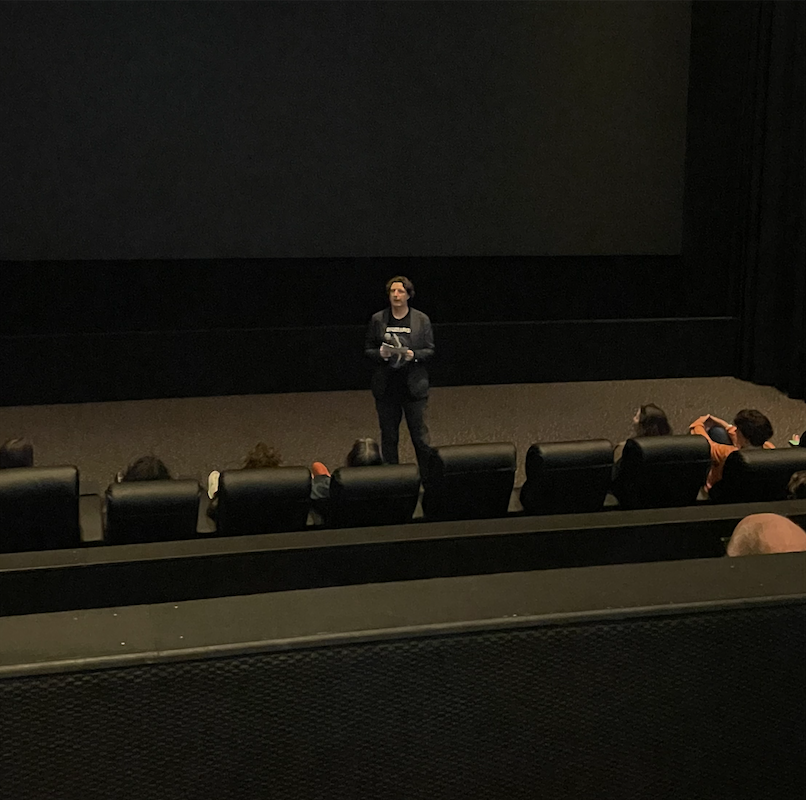
The list of speakers included the Hon. Courtney Houssos; Senator Andrew Bragg; Prof. the Hon. Bob Carr; Trudi Mares ,the Deputy Secretary of Planning, Integration and Passenger, Transport for NSW; former Australian Ambassador to the USA, Arthur Sinodinos; the Hon. Paul Scully, MP and NSW Minister for Planning and Public Spaces; Grace Vegesana, National Director for the Australian Youth Climate Coalition; Estelle Grech, Planning Policy Manager at Committee for Sydney; and many more.
The agenda included hearing from various analysts, economist, and policy-makers in Sydney about differing reports from the past year, such as the ‘Life in Sydney’ report and the ‘State of the City’ report; panel discussions exploring productivity and prosperity in an era of uncertainty; ‘Big Idea’ pecha kucha presentations to envision new visions of Sydney by 2027; political conversations and federal election analysis in anticipation of this years federal election; considerations around climate change and how it will affect the city; and understanding how unpaid labour and the time-cost of caring responsibilities has an affect on the workforce in Sydney. Throughout the summit, audience members were invited to vote on what questions they would like discussed in panels.
Urban wetlands in Australia are under threat, yet they provide benefits for climate change mitigation, pollution reduction, habitat provision, and socioecological connection. In what is now known as Sydney’s inner south and inner west, wetlands were significant places maintained by Aboriginal peoples for millennia (Foster). The violent colonial history that shaped Sydney unfolded along its extensive and dynamic wetlands and connecting waterways. Water was enclosed, drained, dammed, and channelled underground to service the city’s growth. “Unproductive swamps” were filled in for factories and housing.
Today, in an era of unprecedented urban growth, wetlands are making a comeback, with urban renewal projects incorporating artificial systems into water-sensitive urban design with shallow, densely planted ponds that help filter water through physical and biological processes. Artificial wetlands in densely populated areas are increasingly recognised for their effectiveness in reducing the runoff volume and the level of pollutants before stormwater enters urban creeks, rivers and oceans. They are “a key technology in the design of water-sensitive urban centres” (Fitzgerald 171).
Although some Sydney wetlands are revered and protected without question, such as the Ramsar-listed Towra Point Nature Reserve, others are undervalued as urban ecologies. Green infrastructure such as wildlife corridors, verges, rain gardens, pocket parks, and artificial wetlands are not well understood as being both on Country and connected to infrastructure (pipes and drains), ecosystems (critters, plants, and groundwater) and leisure activities (pets, sports, walking, running, and being together). It has been pointed out that focussing on wetlands only as habitat for waterbirds or iconic species “creates an exclusionary environmental protection practice that can have adverse consequences for an ecosystem intrinsically connected to its surroundings, as wetlands are” (McDonald and Gillespie 3).
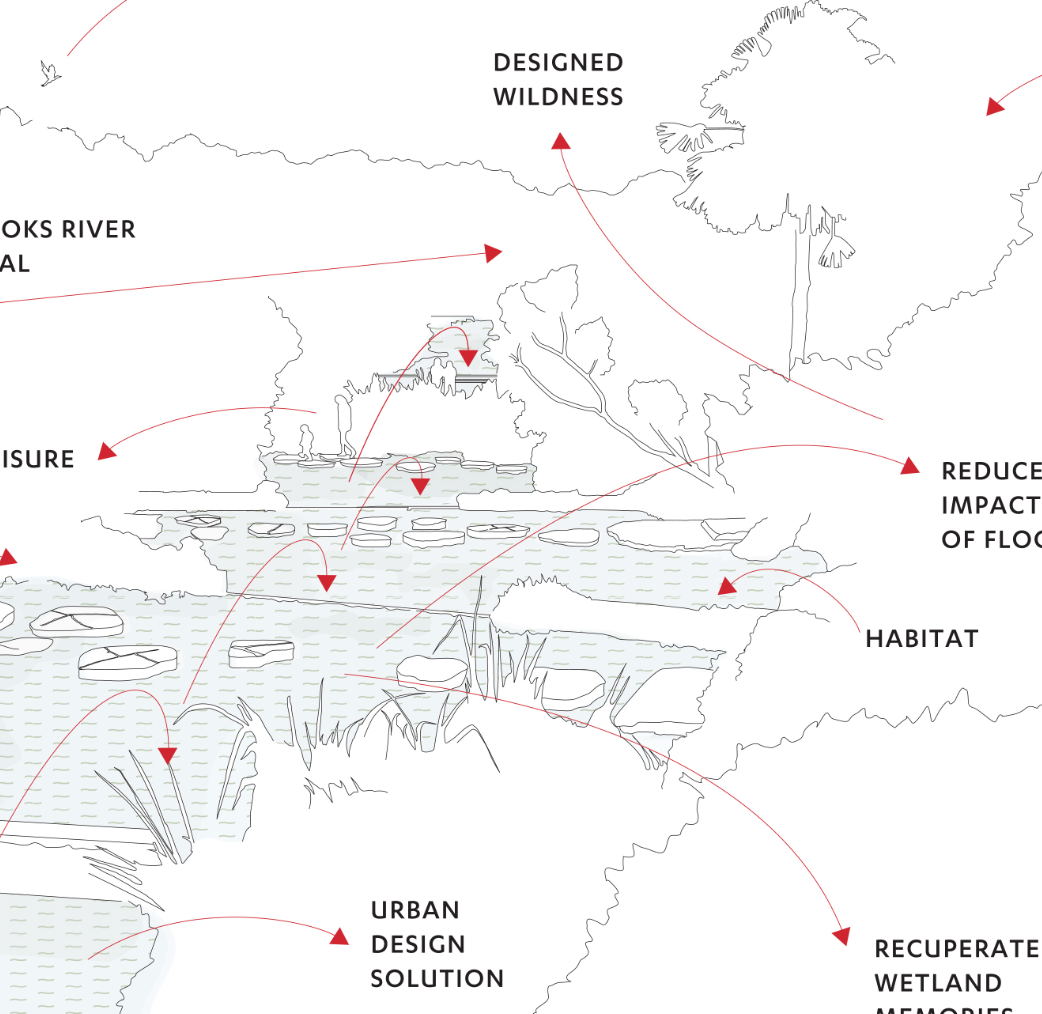
In this article, we examine an artificial wetland at Sydney Park, adjacent to the Green Square urban renewal site. Through a visualisation method we call “photo diagramming” (Jones et al.), we ask the question: how might visual communication play a role in helping to make artificial wetlands more legible as socioecological systems?
First, we offer a brief history of Sydney Park, also describing how the artificial wetlands were designed. Then, we introduce our photo diagram, which shows how artificial wetlands operate as contact zones between the human-centred and more-than-human needs of cities, generating the edges necessary for recombinant ecologies to thrive (Crosby et al.). Finally, we explore what we can learn from a visual appreciation of artificial wetlands in urban Countries that might translate to other artificial yet beneficial aspects of urban environments.
We’re excited to announce that we will be showing some of our teams work at the upcoming ‘Walk With Me’ exhibition at DrawSpace from the 28th of November to the 22nd of December.
The exhibition presents six projects that foreground preoccupations with and responses to habitat loss and species extinction, connection with urban ecologies, the colonial project, artistic and scientific activity centred on walking, and site-specific atmospheres, among other concerns. Each project generates drawing as an output, and the teams photodiagrams, and Holly’s ‘Disobedient Wildlife’ will be on display, as well as the outcome of a series of workshops. On the 30th of November, Alexandra Crosby, Ilaria Vanni, Sarah Jane Jones, and Holly O’Neil will be leading an ethnographic walk tracing the flow of stormwater from DRAW Space in Newtown to the wetlands at Sydney Park.
The exhibition presents six projects that foreground preoccupations with and responses to habitat loss and species extinction, connection with urban ecologies, the colonial project, artistic and scientific activity centred on walking, and site-specific atmospheres, among other concerns. Each project generates drawing as an output, and the teams photodiagrams, and Holly’s ‘Disobedient Wildlife’ will be on display, as well as the outcome of a series of workshops. On the 8th of December, Holly O’Neil will be joined by bird-watching guide Jace Peace on a walk through the Sydney Park Wetlands to spot the unruly critters of Sydney, exploring how drawing on location can help to tell stories of place, and allow us to see and investigate the layers of history and habitat around us.
As part of the current exhibition at UNSW, ‘Living Waters: 75 years of water research at UNSW’, CI Ilaria Vanni and RA Holly O’Neil attended the ‘Yanma badhu (Dharug) – Water Walk’. A walk curated by Clare Britton and Troy Reid to invite audiences to consider “how water moves through and on Bidgigal and Kamaygal Land, as it winds its way under urban streets, pools in golf courses, and rises through ancient aquifers to flood “reclaimed” dyuwumba/ swampland.”
The walk began in the exhibition, in the heart of the UNSW library. An exhibition which captured varying creative and valuable research into waters throughout Australia, conducted by researchers and creatives out of a multidisciplinary group from UNSW.
The walk began with a Welcome to Country by Aunty Rhonda Dixon Grovenor, a Gadigal/Bidgigal/Yuin Elder and Traditional Descendant from the Sydney (Warrane) and saltwater basin and the South Coast of NSW.
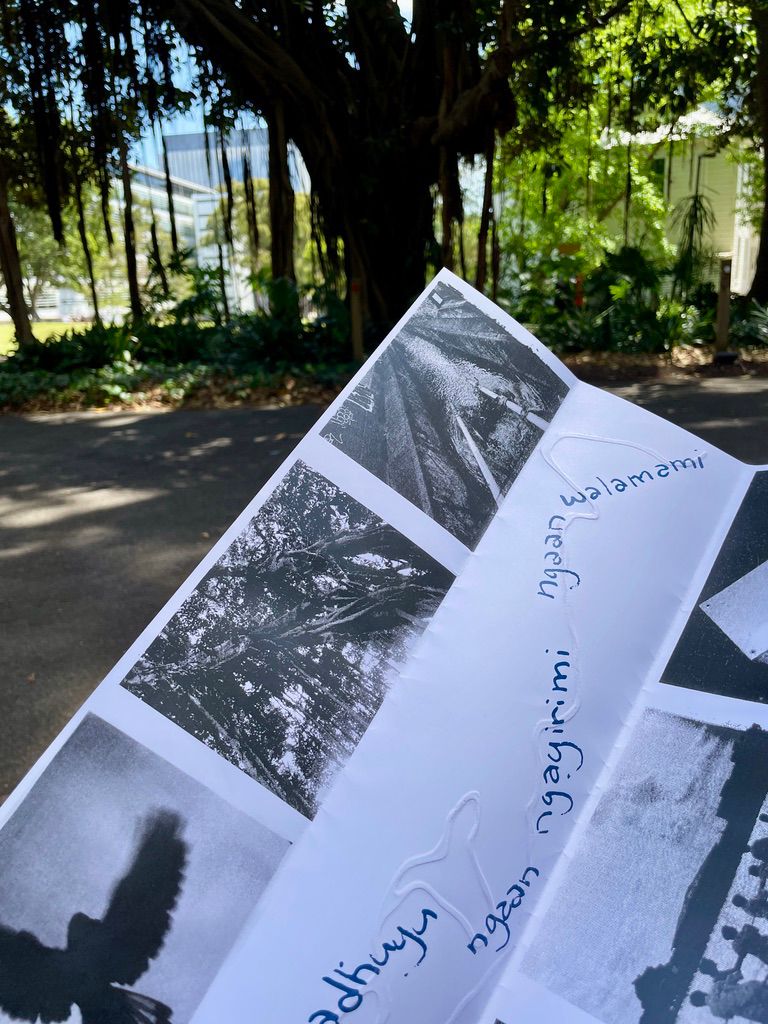
We continued down to the fig trees that sit amidst UNSW’s modern campus, where Associate Professor, Bernadette (B) Hardy reflected on connecting to Country, and invited us to “seek permission” from these ancient figs – to consider both the trauma and joy these natural entities can hold space for. We were invited by walk facilitators to draw, in chalk, beneath the tree: capturing the ever-changing, dappled light on the pavement below.
Continuing on, we followed the water that would have made up the swamplands under UNSW, shifting “downstream” to the sports field, where a vast astroturf pitch, cafes, and a running track sit. Underneath these fields, lie stormwater tanks, holding vast amounts of water, but prior to this this area of the campus would flood, creating a lake. Showing us an image from the 70’s of a group of students playing tug-of-war in the waters, the walk facilitators invited us to embody this image, walking onto the turf and enacting, in place, this moment in time. It was a performative and embodied way of re-living, in-situ, what had been before. A time travel of sorts.
We continued our walk down towards the UNSW Creative Lab, a basement level set of studios which, in recent years, have been prone to flooding. Due to concerns of damage, two separate systems were put in place to monitor water levels within the aquifer below the buildings foundations. These are equipped with sensors, that warn staff in the lab of flooding risks. However, these “portals” (Vanni), mean that by unscrewing the cover and reaching down and into the holes in the floor, one is able to touch the sandy aquifer and pull up sand from it. Aunty Rhonda reached down to take a handful of that sand in a moment, as B Hardy reflected, of connecting the original custodians of the land to the aquifer after over 200 years. This immediate connection to the natural ground and Country beneath the foundations of the building, brought home the layers of time and space on which we walk and live our lives, and how physically close we are to these connections.
After the walk, CI Ilaria Vanni, continued to follow the water. She found this drain, it is part of a canal at the back of NIDA, and she speculates that it may have been a creek. It is easy to imagine how these wetlands may have been connected to Green Square, and walking to try to follow the water helps to make those connections. After following this water, Vanni questions if their connection was in fact likely, based on the steep hill she climbed and a ridge along the Australian Golf Course.
Over at Airspace Gallery in Marrickville, we are part of the current exhibition and project ‘The Catchment‘, alongside Aunty Rhonda & Clare Britton, Asher Milgate, Danny Wild, and the Cooks River Alliance.
The exhibition explores the significance of the Cooks River Catchment, as both “as an ecological reality and cultural community.”
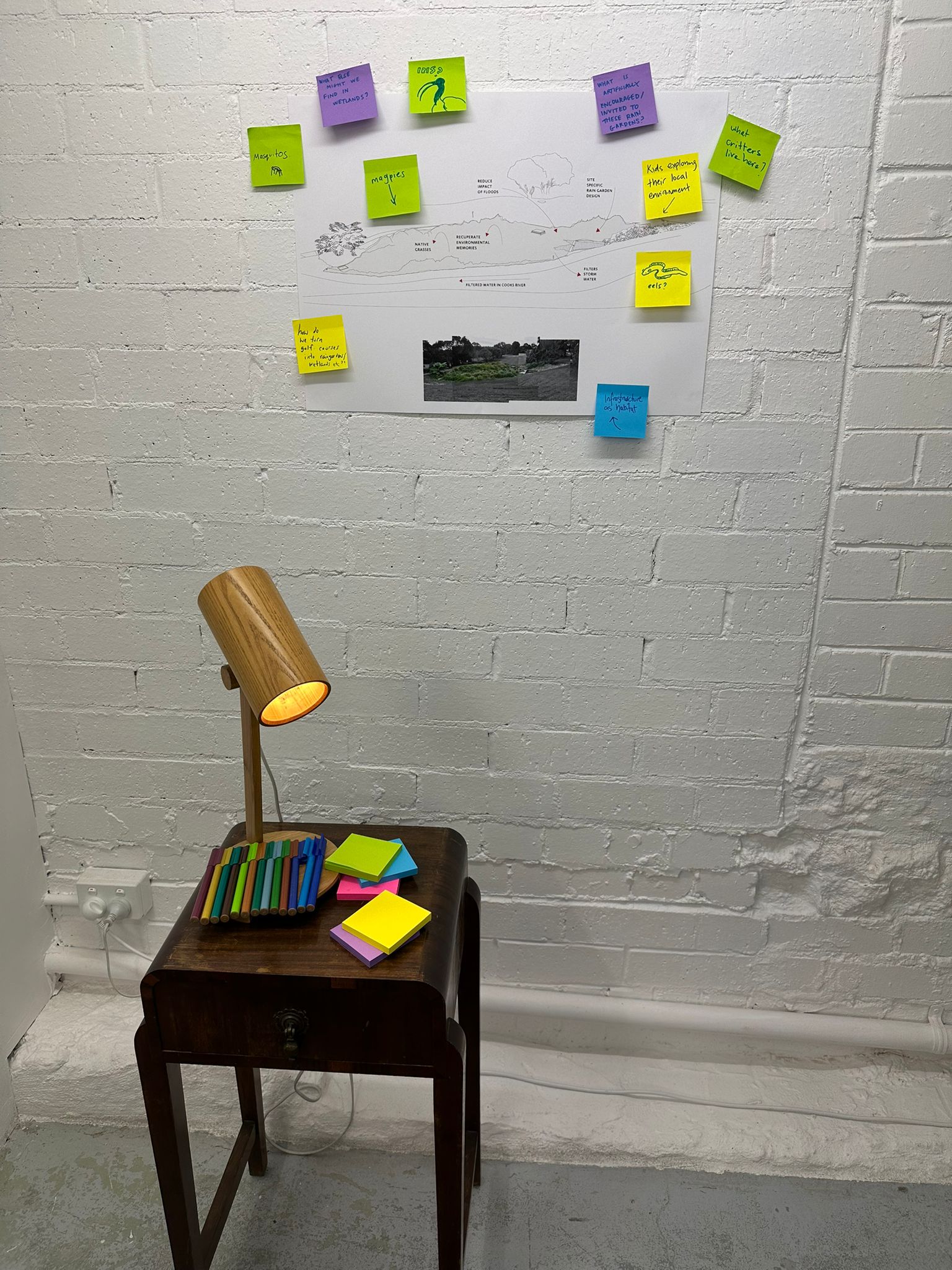
Utilising the teams photodiagrams from the Sydney Park stormwater rain garden, we activated the work to engage with local stakeholders, asking questions such as “What is artificially invited into these spaces?”. Participants are encouraged to write or draw their own views and inputs on post-it notes, sticking them alongside the photodiagrams to create conversations of space, ecologies, and cultural significance.
The show is on until the 17th of November, so see you there!
We joined Gallery 76 at the Embroiderer’s Guild NSW for a talk with artist and president of the Guild, Judith Burns. Judith reflected on the creative journey that lead to the exhibition, and her friendship with Barkandji Elder, Badger Bates, and how his lifelong relationship with the Baaka River (Darling river) has been affected by the impacts of urbanisation. The exhibition aims to reflect not only on the colonial legacies that have shaped this river, but also to the pressing existential threats that impact it in the face of development, urbanisation, and waste management. Bates’ work, intricate lino prints and metalworks reflecting scenes of nature, river basins, and Story, sit in contrast to Burns’ detailed embroidered maps, and Julia Paterson’s printed more-than-human portraits and interactive “stitch in”.
Paterson’s project utilises physical mark making to act as witness to the ongoing destruction of the river and the species eradicated. She invites exhibition goers to sit in the gallery space, and embroider a hundred x’s onto scraps of cloth, in doing so marking the hundreds of animals, fish, insects, and plants who have been threatened or destroyed in the destruction of the river.
Ultimately, Paterson’s aim is to combine these embroidered resistance pieces into one large banner, which she will take to the steps of Parliament house to engage in a “stitch in” to raise awareness for the Baaka.
The exhibition’s combination of sculpture, printmaking, embroidery and geographical references calls into ply an intimacy and narrative which “remind us of our duty of care to Country, waterway and each other.”
Member of our team, Dr Juan Francisco Salazar, debuted his new film ‘Cosmographies’ last week in Sydney. The film, a hybrid ethnographic-documentary-cum-sci-fi, was directed by Salazar and draws on his creative collaboration with performance artist Vitoria Hunt and the Lickanantay community, Toconao, Chile. Building from these relationships, this ARC sponsored film brings together narrative sci-fi, ethnographic filmmaking, Indigenous futurisms, and creative experimentation to create a piece of work that captures the ongoing extraction and destruction of the Atacama Desert, juxtaposing documentary style interviewing with a parallel narrative: a Māori astrobiologist reflecting on the colonisation of extraterrestrial planets.
It was really exciting to see work at this nexus of narrative fiction and documentary, utilising the intangible and the tangible to find meaning. We can’t wait for the world to see this work.